 Under embargo until YYYY-MM-DD
Under embargo until YYYY-MM-DD
https://www.w3.org/ — DD Month 2020 — The World Wide Web Consortium (W3C) announced today that Web of Things (WoT) Architecture and Web of Things (WoT) Thing Description (TD) are now official W3C Recommendations. These complement existing standardized web technologies to enable easy integration across Internet of Things (IoT) platforms and applications. The Web of Things counters the fragmentation of the Internet of Things, reduces costs for developing and deploying Internet of Things services, lessens the risk to both investors and customers, and enables and encourages exponential growth of open markets of devices and services.
@@quote
The goal of the WoT is to enhance interoperability and counter fragmentation in IoT using a cross-ecosystem approach. In particular, rather than prescribing behavior, interfaces, or data models, the WoT Thing Descriptions provide a common way for descriptive information (metadata) about these key aspects of IoT devices and services to be communicated. The ability to share service metadata is a key enabler of an open market for IoT devices and services.
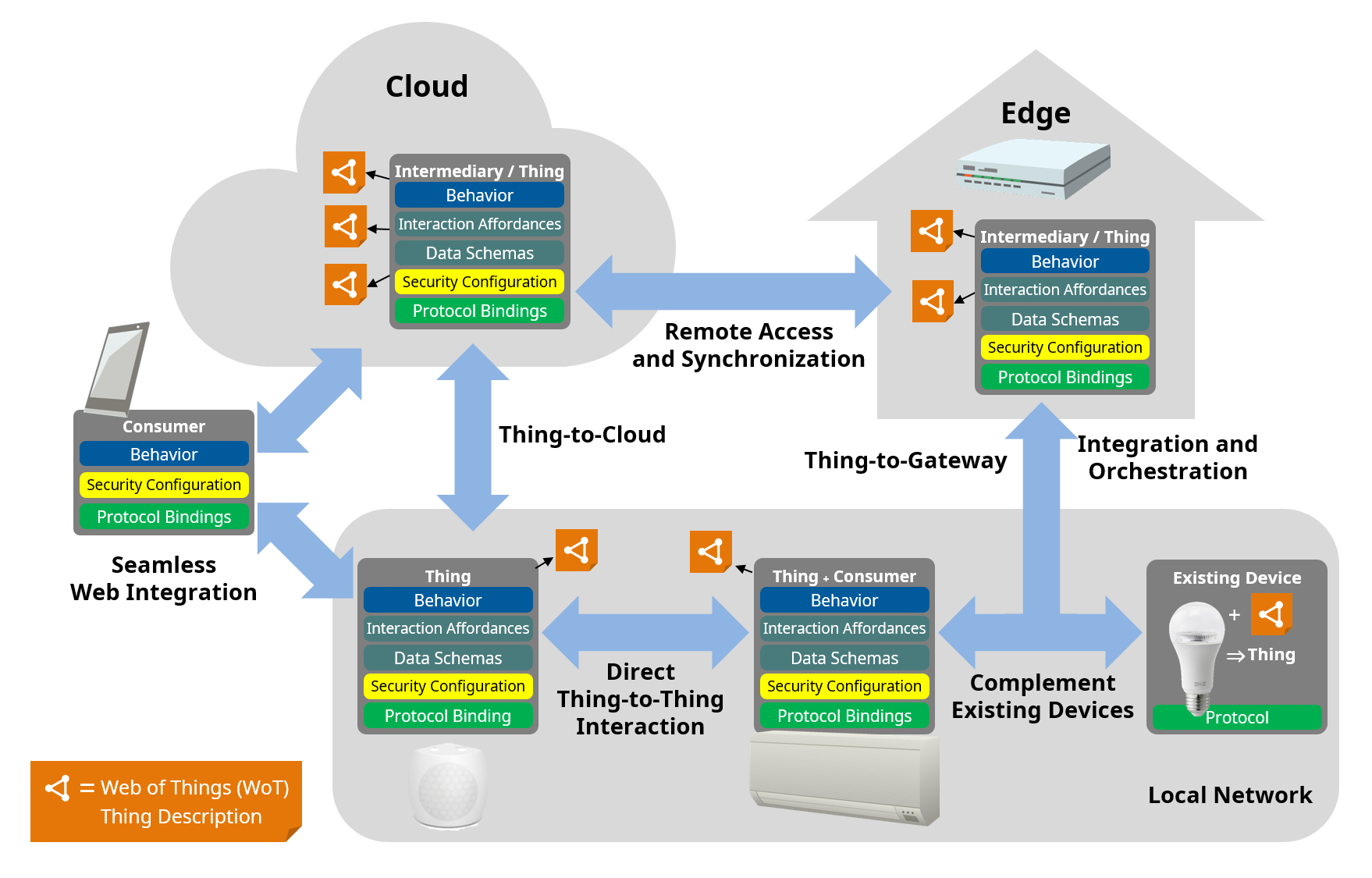
The two WoT documents that have recently become W3C Recommendations define the WoT Architecture and the WoT Thing Description (TD). The WoT Architecture document describes the overall Web of Things conceptual framework. The WoT Thing Description provides a standard way for the metadata of a Thing to be provided, including descriptions of its network API, semantics, and data models. The WoT Working Group and Interest Group have also published some related informative documents: the WoT Security and Privacy Guidelines, the WoT Scripting API, and the WoT Binding Templates. The WoT Binding Templates describe how WoT Thing Descriptions can be used with specific concrete protocols. The WoT Scripting API provides a common way to access and process WoT Thing Descriptions from within applications.
The Web of Things is applicable to multiple IoT domains, including Smart Home, Industrial, Smart City, Retail, and Health applications. In general, the use of W3C WoT standards can simplify the development of IoT systems that combine devices from multiple vendors and ecosystems. For different kinds of users, the W3C WoT standard can provide specific benefits:
The WoT WG has recently renewed its charter and will be addressing a number of new issues, including discovery, onboarding, and enhancing interoperability via a profile mechanism. See the new WoT WG Charter for details. Additional participants are welcome!
The mission of the World Wide Web Consortium (W3C) is to lead the Web to its full potential by creating technical standards and guidelines to ensure that the Web remains open, accessible, and interoperable for everyone around the globe. W3C well-known standards HTML and CSS are the foundational technologies upon which websites are built. W3C works on ensuring that all foundational Web technologies meet the needs of civil society, in areas such as accessibility, internationalization, security, and privacy. W3C also provides the standards that undergird the infrastructure for modern businesses leveraging the Web, in areas such as entertainment, communications, digital publishing, and financial services. That work is created in the open, provided for free and under the groundbreaking W3C Patent Policy. For its work to make online videos more accessible with captions and subtitles, W3C received a 2016 Emmy Award. And for its work to standardize a Full TV Experience on the Web, W3C received a 2019 Emmy Award.
W3C's vision for "One Web" brings together thousands of dedicated technologists representing more than 400 Member organizations and dozens of industry sectors. W3C is jointly hosted by the MIT Computer Science and Artificial Intelligence Laboratory (MIT CSAIL) in the United States, the European Research Consortium for Informatics and Mathematics (ERCIM) headquartered in France, Keio University in Japan and Beihang University in China. For more information see https://www.w3.org/.
End Press Release
Amy van der Hiel, W3C Media Relations Coordinator <w3t-pr@w3.org>
+1.617.253.5628 (US, Eastern Time)
The new WoT standard enables Siemens to better combine and analyze data from different systems and domains in a very simple yet meaningful way. We use WoT e.g. to integrate devices and subsystems into our flagship building management station Desigo CC and from there to the cloud. Heterogenous and proprietary OT and IoT solutions caused in the past significant engineering and maintenance effort, e.g. if you wanted to analyze holistically data from different sources in a building. Using WoT we can quickly integrate data from different devices into a data pool and use that pool for further value creation, e.g. analytics, engineering, validation, energy optimization.
Helmut Macht, Chief Technology Officer, Siemens
@@Message@@
Member representative name, title
@@Message@@
Member representative name, title
@@Message@@
Member representative name, title
@@Message@@
Member representative name, title