 Under embargo until YYYY-MM-DD
Under embargo until YYYY-MM-DD
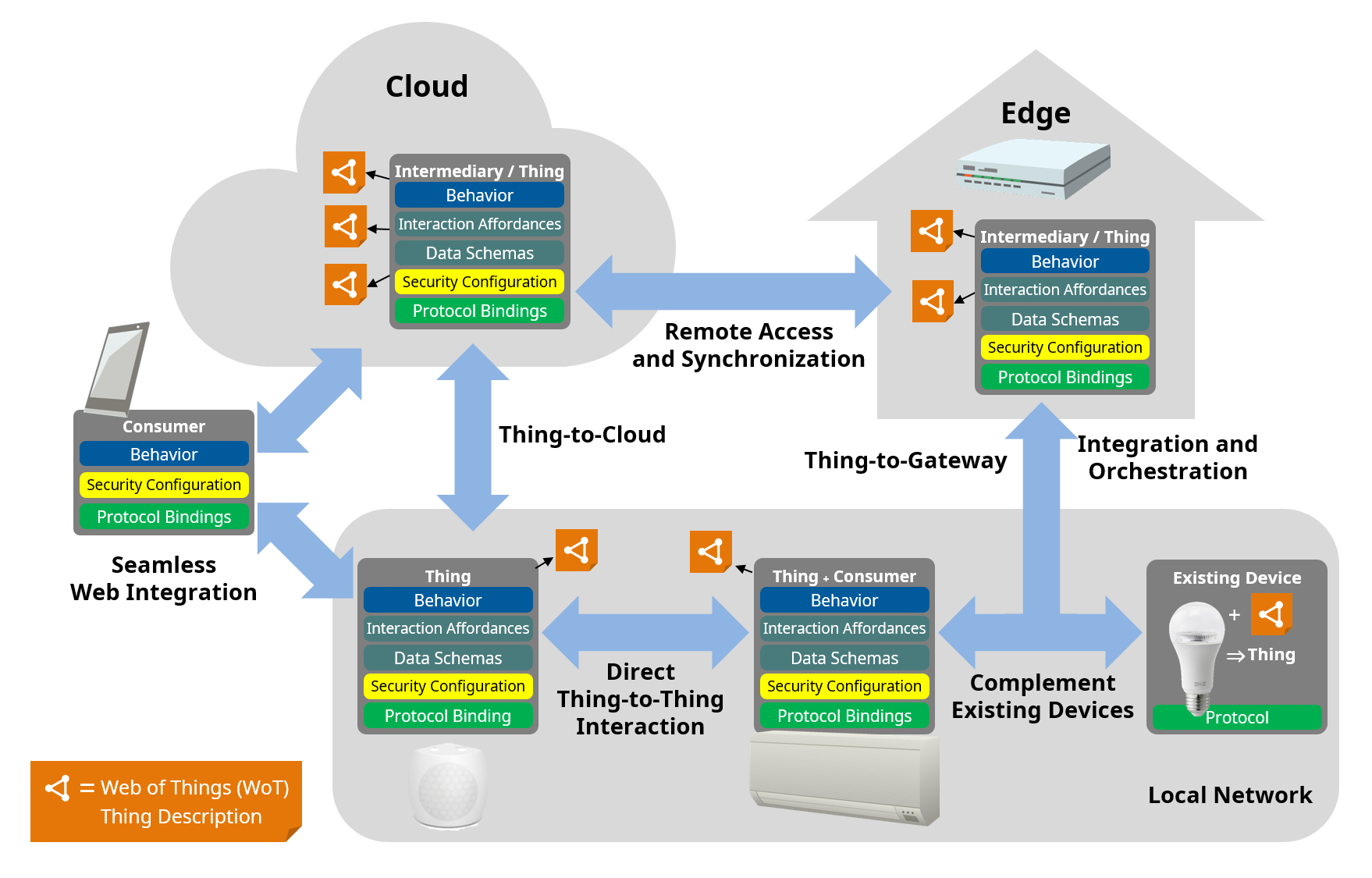
https://www.w3.org/ — DD Month 2020 — The World Wide Web Consortium (W3C) announced today that Web of Things (WoT) Architecture and Web of Things (WoT) Thing Description (TD) are now official W3C Recommendations. These complement existing standardized web technologies to enable easy integration across Internet of Things platforms and applications.
@@quote?
The diversity of technologies used in Internet of Things (IoT), such as protocols and data models, typically causes high integration and maintenance costs in IoT projects. The mission of the Web of Things activities is to counter the fragmentation of the Internet of Things by defining a Web-based abstraction layer for, e.g., existing platforms, devices, gateways and services. By complementing existing standards, it reduces risk for investors and customers as well as enables rapid growth of open markets for devices and services.
Two baseline specifications have been developed since the launch of the Web of Things Working Group. They define an abstract architecture and several building blocks and a common data format for describing devices and services:
The WoT Thing Description is to the Internet of Things what index.html is to a website: it can be considered as the entry point of a physical or virtual Thing/device. The WoT building blocks increase interoperability for IoT applications and reduce integration efforts and costs.
During the course of the Web of Things standardization activities, several other informative documents were also created, such as WoT Scripting API, WoT Security and Privacy Guidelines, and WoT Binding Templates.
The goal of the WoT is to enhance interoperability and counter fragmentation in IoT using a cross-ecosystem approach. In particular, rather than prescribing behavior, interfaces, or data models, the WoT Thing Description provide a common way for descriptive information (metadata) about these key aspects of IoT devices and services to be communicated with. The ability to share service metadata is a key enabler of an open market for IoT devices and services.
The two WoT documents that have recently become W3C Recommendations define the WoT Architecture and the WoT Thing Description (TD). The WoT Architecture document describes the overall Web of Things conceptual framework. Whereas the WoT Thing Description provides a standard way for the metadata of a Thing to be provided, including descriptions of its network API, semantics, and data models. The WoT Working Group and Interest Group have also published some related informative documents: the WoT Security and Privacy Guidelines, the WoT Scripting API, and the WoT Binding Templates. The WoT Binding Templates describe how WoT Thing Descriptions can be used with specific concrete protocols. The WoT Scripting API provides a common way to access and process WoT Thing Descriptions from within applications as well as to interact with the Things.
The Web of Things is applicable to multiple IoT domains, including Smart Home, Industrial, Smart City, Retail, and Health applications. In general, the use of W3C WoT standards can simplify the development of IoT systems that combine devices from multiple vendors and ecosystems. For different kinds of users, the W3C WoT standards provide the following specific benefits:
The WoT WG has recently renewed its charter and will be addressing a number of new enhancements, including discovery, onboarding, and profile mechanism. See the new WoT WG Charter for details. Additional participants are welcome!
The mission of the World Wide Web Consortium (W3C) is to lead the Web to its full potential by creating technical standards and guidelines to ensure that the Web remains open, accessible, and interoperable for everyone around the globe. W3C well-known standards HTML and CSS are the foundational technologies upon which websites are built. W3C works on ensuring that all foundational Web technologies meet the needs of civil society, in areas such as accessibility, internationalization, security, and privacy. W3C also provides the standards that undergird the infrastructure for modern businesses leveraging the Web, in areas such as entertainment, communications, digital publishing, and financial services. That work is created in the open, provided for free and under the groundbreaking W3C Patent Policy. For its work to make online videos more accessible with captions and subtitles, W3C received a 2016 Emmy Award. And for its work to standardize a Full TV Experience on the Web, W3C received a 2019 Emmy Award.
W3C's vision for "One Web" brings together thousands of dedicated technologists representing more than 400 Member organizations and dozens of industry sectors. W3C is jointly hosted by the MIT Computer Science and Artificial Intelligence Laboratory (MIT CSAIL) in the United States, the European Research Consortium for Informatics and Mathematics (ERCIM) headquartered in France, Keio University in Japan and Beihang University in China. For more information see https://www.w3.org/.
End Press Release
Amy van der Hiel, W3C Media Relations Coordinator <w3t-pr@w3.org>
+1.617.253.5628 (US, Eastern Time)
Over the past couple of years, operators in the Convenience Retail Industry have come to a realization: “data” may be a more important asset than “location.” Existing, purpose-built data streams (such as transaction logs) exclude important contextual data, and while IoT data could help fill this gap, operators face big integration challenges in the absence of standards. The lack of standards for defining IoT data also makes it difficult for operators to propose definitions tailored to their needs. Web of Things promises to solve both the integration and the definition problems for retail operators. Conexxus, as the standards organization for Convenience Retail, endorses the Web of Things work and has already begun to use “Thing Descriptions” in current committees. Thanks to W3C for supporting this forward-looking work.
David Ezell, Director of New Initiatives, Conexxus
The interoperability, the WoT standard trying to solve, remains the biggest challenge in IoT. The newly defined Web interface in WoT not only provides unified control over a various IoT devices, but also enables integration with many business systems using Web technologies. In addition, Metadata describing the device functions and Protocol Binding mapping to the device interfaces can also be applied to new communications technologies such as 5G, which are expected to become widespread in the future. Fujitsu believe that WoT is an indispensable technology and will have a significant impact on the digitization of our customers' systems.
Shingo Mizuno, Senior Vice President, Fujitsu Limited
We are pleased to see that "Web of Things" which connects a diverse range of IoT systems through Web technology has now been released as a W3C recommendation. Progress in IoT is driving an accelerated rate of data generated by business and society. Delivering appropriate feedback to the field using this data will lead to the creation of new value. We hope that “Web of Things” will make it easier to access insights and on-site equipment from across a wide range of operations and industry sectors, and enable the agile creation of new value for future society.
Norihiro Suzuki, Vice President & Executive Officer, Chief Technology Officer, Hitachi, Ltd.
This new WoT Standard takes a step forward in addressing the fundamental problem holding back the commercial success of IOT: the challenge of connecting different systems and domains. It provides a solution to enable different systems and domains to communicate and share data.
Eric Siow, Intel Corporation
Internet Research Institute, Inc. welcomes the successful launch of advisories of ‘Web of Things Architecture’ and ‘Web of Things Thing Description’ by W3C. The Internet has been taking on a role to connect people to people with organizations through Web Technology. Accordingly, due to the spread of the IoT Technology, the Web Technology has found itself a new role of connecting various things to the Internet. It means, people, things and organization can now freely exchange information and data through the Web Technology. Furthermore, as 5G services spread, it is easy to imagine the combination of IoT Technology and Web Technology can lead us towards a prosperous future.
In fact, there are various protocols for IoT Technology exists today in the world, but unfortunately the interoperability of information and data exchange in between people and things, organization and things, things and things, are not being realized. In this situation, we are certain that ‘Web of Things Architecture’ and ‘Web of Things Thing Description’ will become the solution for this matter.
We are at the age of seeing out the preceding era of Internet that mainly connects people and seeing in an era of its connecting things. Therefore we strongly believe that WoT Technology could take a important role to develop a wide variety of the Internet services. In the future, we intend to proactively implement the development of services using WoT Technology.
Hiroshi Fujiwara, CEO, Internet Research Institute, Inc.
Lack of interoperability standards and a highly fragmented ecosystem full of proprietary interfaces have been major hurdles for enterprise adoption of IoT technologies. These issue have been compounded by the wide range of proprietary data formats and connectivity protocols that are used across many different industries, making it very difficult to build IoT platforms that can be quickly extended for a large range of use cases. At Oracle we are thrilled that W3C Web of Things is addressing these issues head-on with the W3C Web of Things Specifications. Open standards have always opened up closed markets and driven rapid technology adoption. We firmly believe that this IoT ecosystem and the W3C Web of Things community will play a major role in bringing IoT technologies mainstream, and become a catalyst for a number of innovations benefitting a wide range of industries.
Jai Suri, Senior Director, Internet of Things Cloud, Oracle
Panasonic is delighted with the publication of the Web of Things Recommendations. Our company has been involved in Web of Things activities since the first Web of Things Workshop in 2014 and has contributed to the formulation of the Recommendation through technical proposals and Plugfest. Panasonic is now transforming itself into a company that achieves “Lifestyle Updates”. We believe that the Web of Things will be one of important technologies contributing to this transformation.
Yoshiyuki Miyabe, Senior Managing Executive Officer and CTO, Panasonic Corporation
The new WoT standard enables Siemens to better combine and analyze data from different systems and domains in a very simple yet meaningful way. We use WoT e.g. to integrate devices and subsystems into our flagship building management station Desigo CC and from there to the cloud. Heterogenous and proprietary OT and IoT solutions caused in the past significant engineering and maintenance effort, e.g. if you wanted to analyze holistically data from different sources in a building. Using WoT we can quickly integrate data from different devices into a data pool and use that pool for further value creation, e.g. analytics, engineering, validation, energy optimization.
Helmut Macht, Chief Technology Officer, Siemens